Making the FrameRate brand manifesto
How The Furrow built a brand film about craft, community, and the creators who make the work worth watching.
Most clients think they know what they want. And they're usually wrong. We were no different.
Our original goal was to create a simple brand film. You've seen the recipe before:
Start with vaguely optimistic electronic music.
Introduce the logo as a platonically ideal construction of shapes.
Sprinkle in some slick animations showing off the palette and type system.
End with another logo reveal as the music comes to a crisp, satisfying finish.
Simple. And that's what we wanted. We thought.
But then, during our first meeting with The Furrow, they started doing something really interesting: they asked questions. Things like…
Who specifically are you trying to reach with this film?
How are you hoping to change their behavior?
How will this film be used, and where will it live?
What exactly are you trying to say?
And that reframed everything. Collaborating with The Furrow both broadened our thinking and sharpened it. They brought intentionality to the entire project.
Over the last seven weeks, we went on a deeply satisfying journey together. Here are some of the highlights from that odyssey.
It's not me, it's you
The first script that I wrote was, in a word, boring.
It was a traditional approach to a brand rollout, stepping you through the design system created by Studio K via some mildly poetic voiceover. Not bad, but also not great.
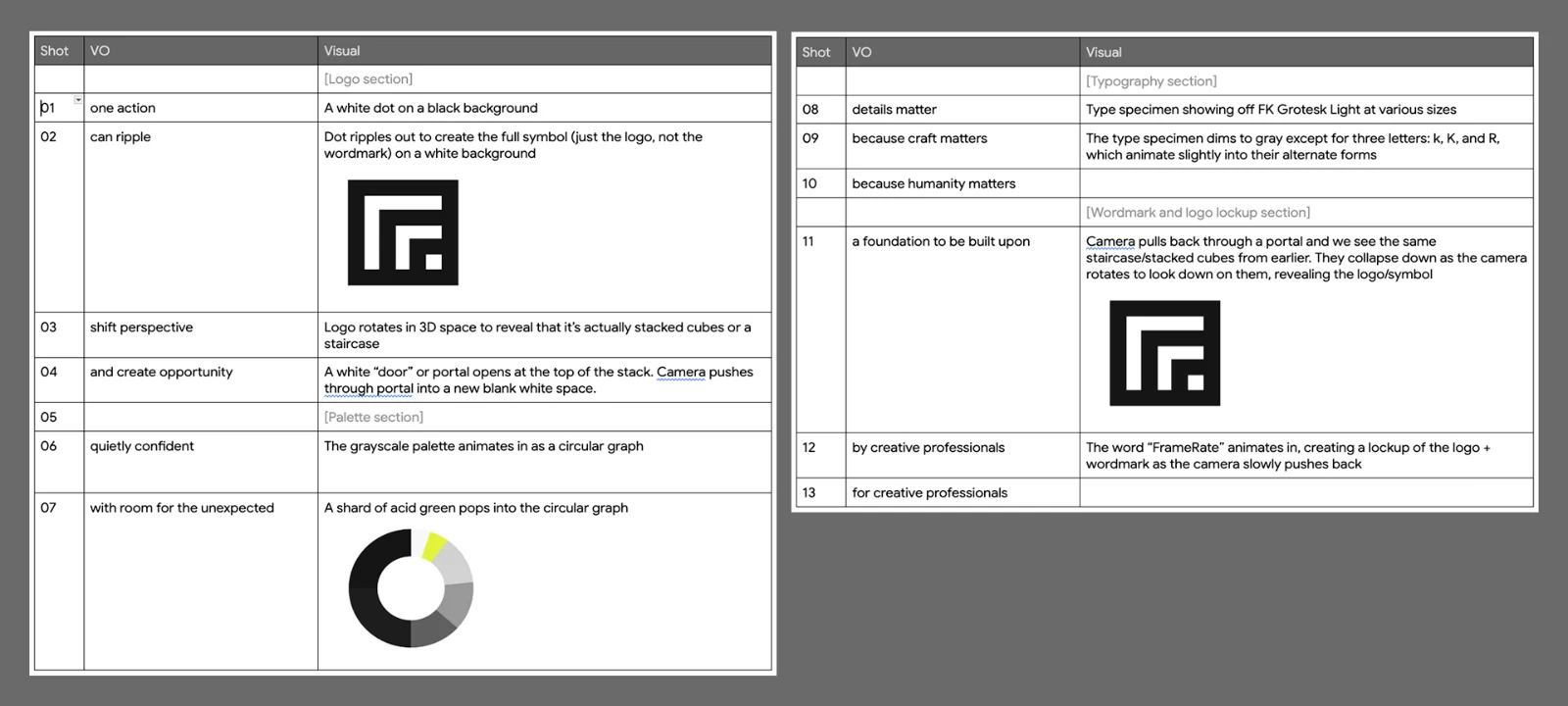
To bust out of the mental bubble we found ourselves in, we invited The Furrow to a Google Doc and penned literally dozens of revisions with them.
We let ourselves go wild. At one point, I even proposed a script that involved robots sacrificing a marionette at an altar. (No, seriously.)
As we worked through ideas, we realized that anything tied to the current state of the industry was going to read as a time capsule in two years. We wanted something more evergreen than that.
The breakthrough was to address the viewer directly, in second person, about their own work. As the script says:
You've spent hours honing your work.
Perfecting every cut.
Every frame.
Every detail.
That work deserves a new place to call home.
Where craft is the focus.
Where you have full control.
Where community means opportunity.
A place where you belong.
The platform itself never appears. The whole piece is told through visual metaphors, and the closest it gets to a pitch is the idea that FrameRate is a place to belong, not a set of features wrapped in a UI.
Just specific enough
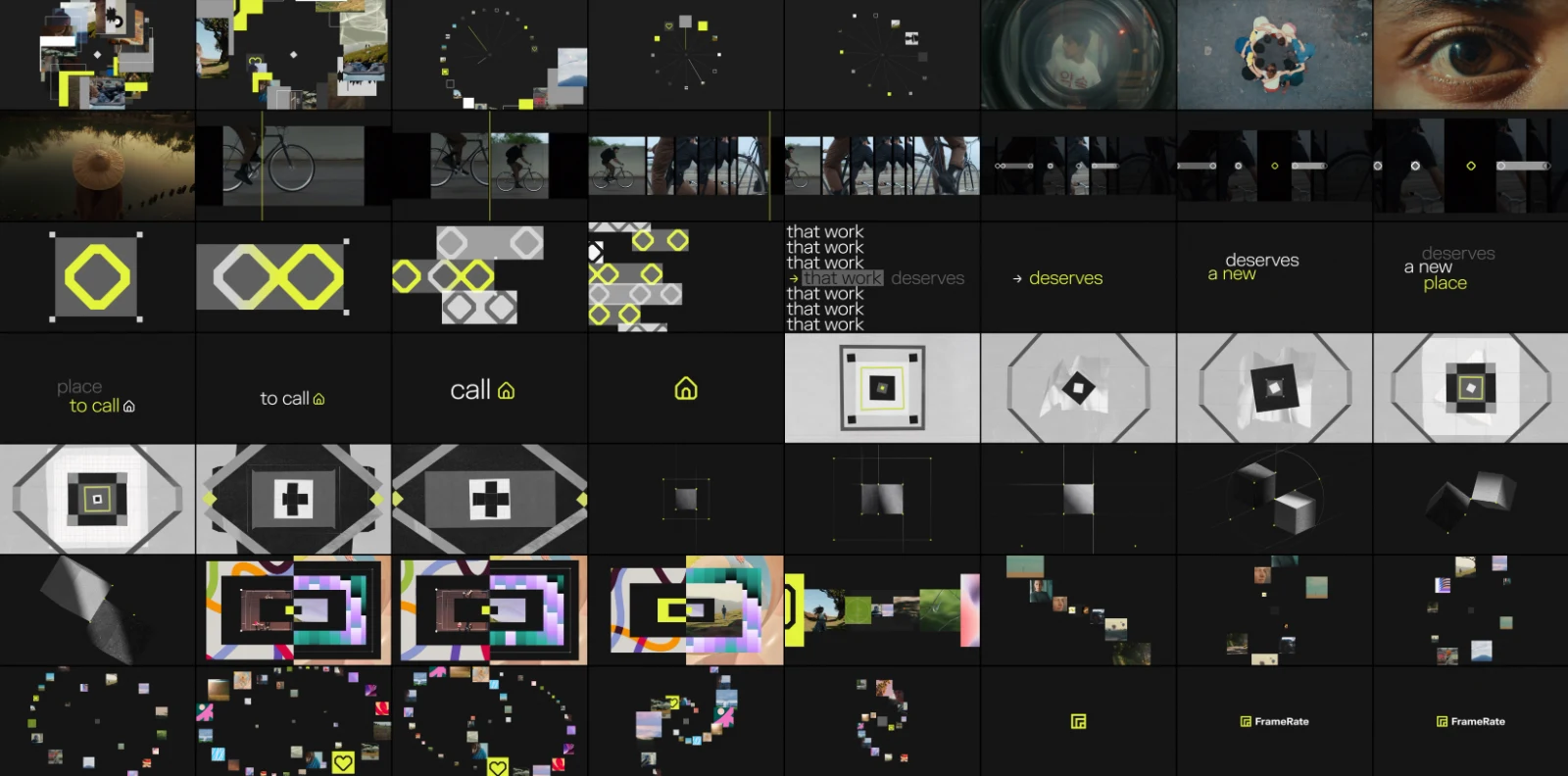
The central tension of the entire film is a balancing act between abstraction and specificity, between metaphor and literalism.
That tension fueled the evolution of the brand's motion direction, letting frame rate, composition, and transition do as much story work as type and color.
The development of the “every frame, every detail” sequence illustrates the point well.
The Furrow's first pass was a zoetrope-style transition that pays homage to the early days of animation.
But something about the zoetrope idea wasn't translating. We needed something simpler, something more universally relatable. We asked, “What's the one thing every person in our audience touches every day?”
The answer was simple: The timeline. Like first loves, everyone remembers their first timeline. (Incidentally, mine was Macromedia Flash 3, circa 1999. 💖)
The sequence evolved into a playhead crossing the frame as the camera pulls out to reveal the rest of the edit. Abstract enough not to feel like a screenshot. Familiar enough that anyone watching can see their favorite tool reflected back to them.
Frame rate as a storytelling device
If you're an animator, here's a detail you might catch.
The final render is 24 fps, but inside the piece, frame rates are constantly being dialed up and down. Lower frame rates punch up the craft aspect, the intervention of a human hand. Higher frame rates are more about precision and perceived performance.
"Craft" takes on more meaning when you can show it, so The Furrow did.
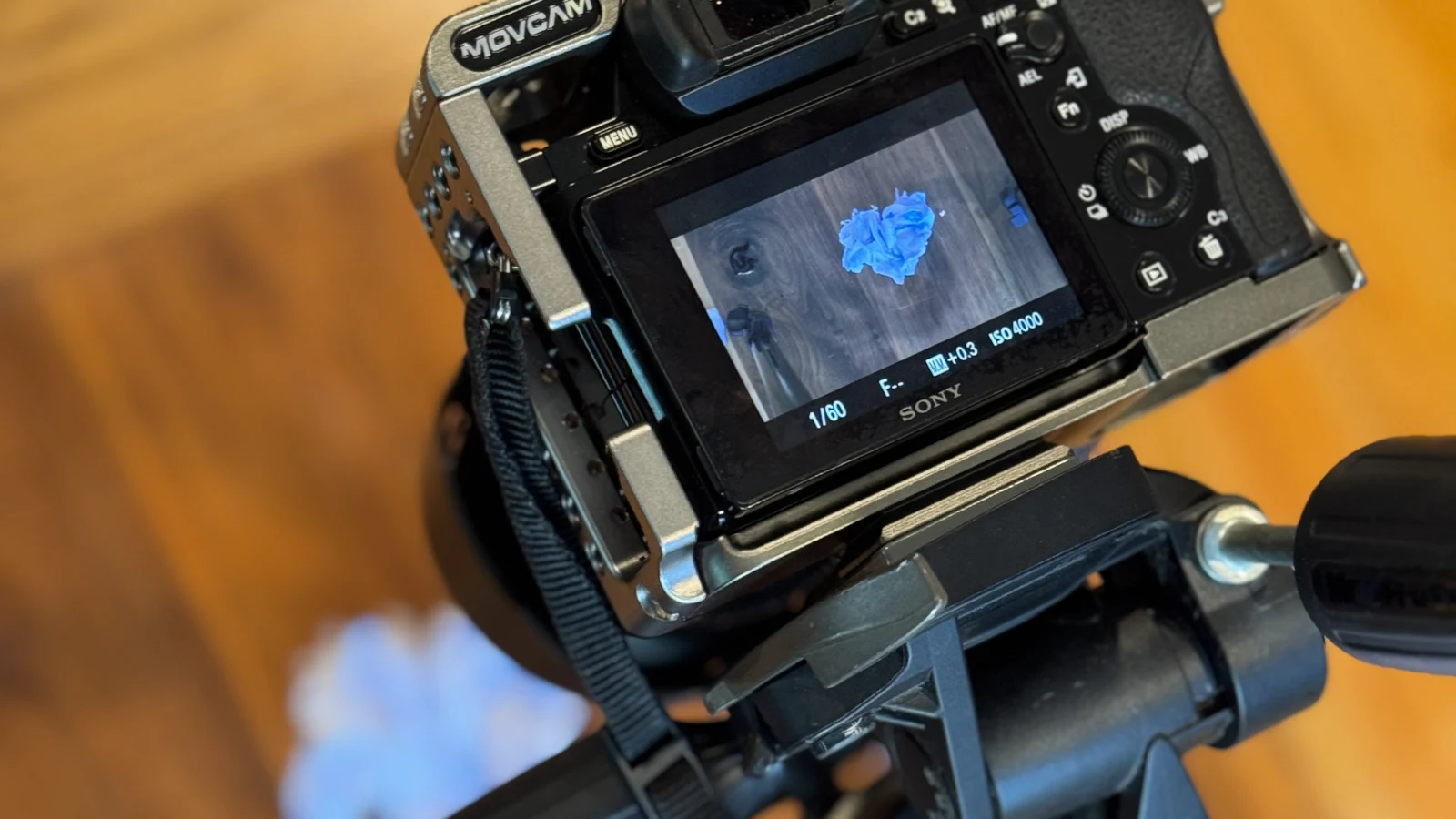
They photographed crumpled paper for some of the layers and matched the animation to its natural imperfection. The frame rate drops and the artist's hand becomes visible right at the moment the script lands on “craft.”
Immediately following is the 3D sequence, which runs at the full 24 fps and is all about pixel-perfect control and cutting-edge tech.
Most viewers won't consciously register any of this. That's fine. Those that see it will appreciate it, and for everyone else, it's working at a subconscious level.
Building a bridge
Speaking of that 3D sequence, it contained its own unique challenge.
The sequence is about "full control," demonstrated through layered perspective. We needed dimensional space without being too busy, so it wouldn't compete with the adjacent scenes highlighting craft (texture-heavy) and community (color-heavy).
The real puzzle was animating the camera to keep content locked while transitioning in a way that felt dynamic but expected. This behind-the-scenes clip shows how tricky it got.
A little splash of acid (green)
This film is the first time the FrameRate identity system is being extended into motion. We had essentially three working colors: black, a stack of grays, and a single acid green (#E4F43C).
The guidelines are explicit that this restrained base exists so user-created work can take center stage. So we tried to apply the same logic to the film.
The Furrow made the acid green do specific work, pointing at what is telling the story in that frame or pulling the viewer's eye to a specific zone of attention.
The community sequence is the one place we let color blow open, which makes conceptual sense. We wanted to reflect the diverse tapestry of talents that you’ll find on FrameRate.
Curation as creation
It wouldn’t have made sense to make a brand film for a platform that explicitly refuses AI training on uploaded work and then put AI-generated visuals in the film. So we didn't.
All of the footage you see was sourced from stock asset sites. The curation that went into that was a mini-project unto itself.
First, The Furrow audited the work that's already on FrameRate to get a sense of what our community is actually making. Then, they trawled through thousands of stock clips, looking for footage that stylistically resonated with the findings from their research.
The final cut features 113 layers from over 500 selects, all intentionally chosen to foster a sense of belonging and familiarity without being predictable or boring.
(Side note: If we'd had all the time in the world, we would have licensed work from the FrameRate community directly, but logistically that just wasn't realistic. That approach would have created a massive bottleneck and derailed the entire timeline.)
Sound as structure
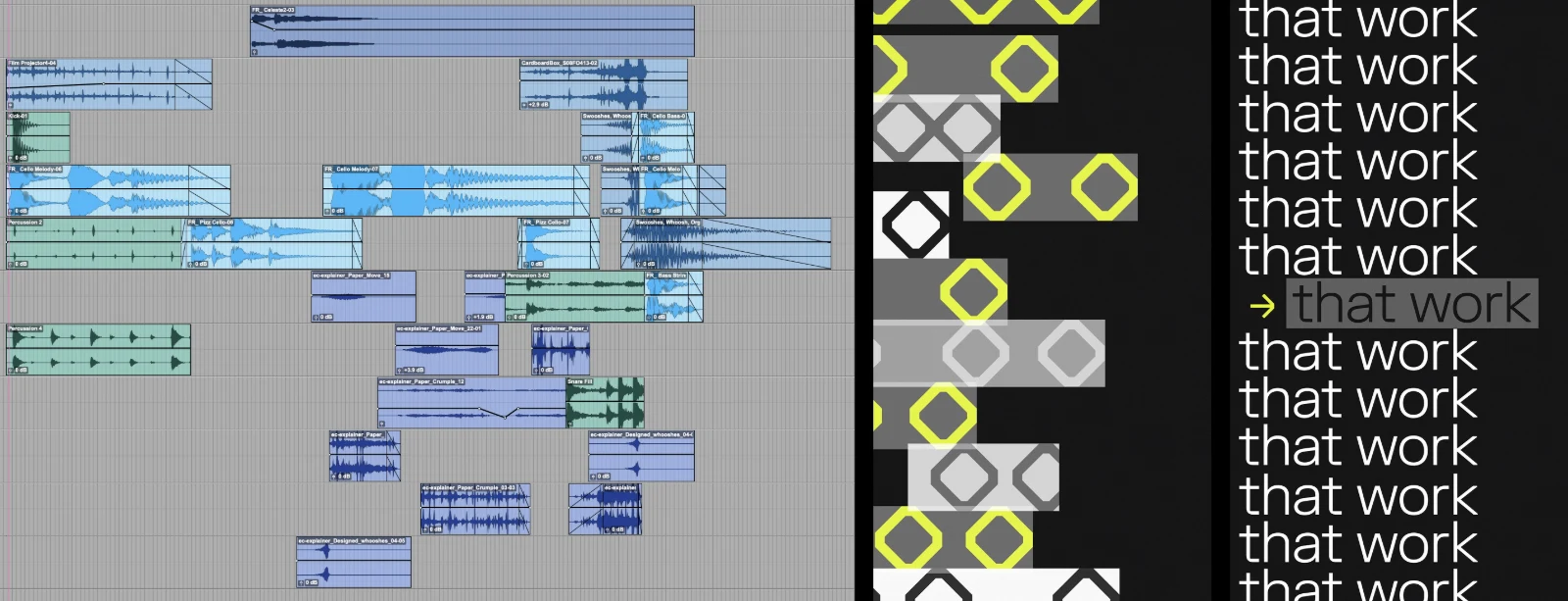
Wesley Slover at Sanctus Audio scored the film and produced the full mix. The audio direction has its own internal logic that runs parallel to the visual side.
To find the sound we were looking for, we essentially had a musical conversation, sending references back and forth and discussing what was working and what wasn't over Slack and during live reviews.
I threw Wesley more than one curve ball, often referencing tracks that were only tangentially related to things we’d discussed. Here's a representative excerpt of a Slack conversation:
May 24, 2026
Justin: I was thinking of something a little bit more rhythmic and playful, something that creates opportunity for animation and fun edits while keeping the energy high.(I recognize that's different than everything we've discussed up to this point. I'm just wondering what happens if we push the envelope a little?)
Some examples:
An extreme example would be something from Antonio Sanchez, like "That's Your Offer?" or even "Follow Me/America's Population"
The sparse instrumentation and playfulness of "Sonata for Cello and Piano in F Minor" (Royal Tenenbaums) is interesting
It's too menacing, but the instrumentation and slightly chaotic, percussive quality of "Proven Lands" is... something 😅
Wesley: Yeah I love these references!
I’m interpreting this as aiming to communicate playfulness in creativity and the fun of community. Where I was [previously] thinking warm-fuzzy feelings. Does that seem correct?
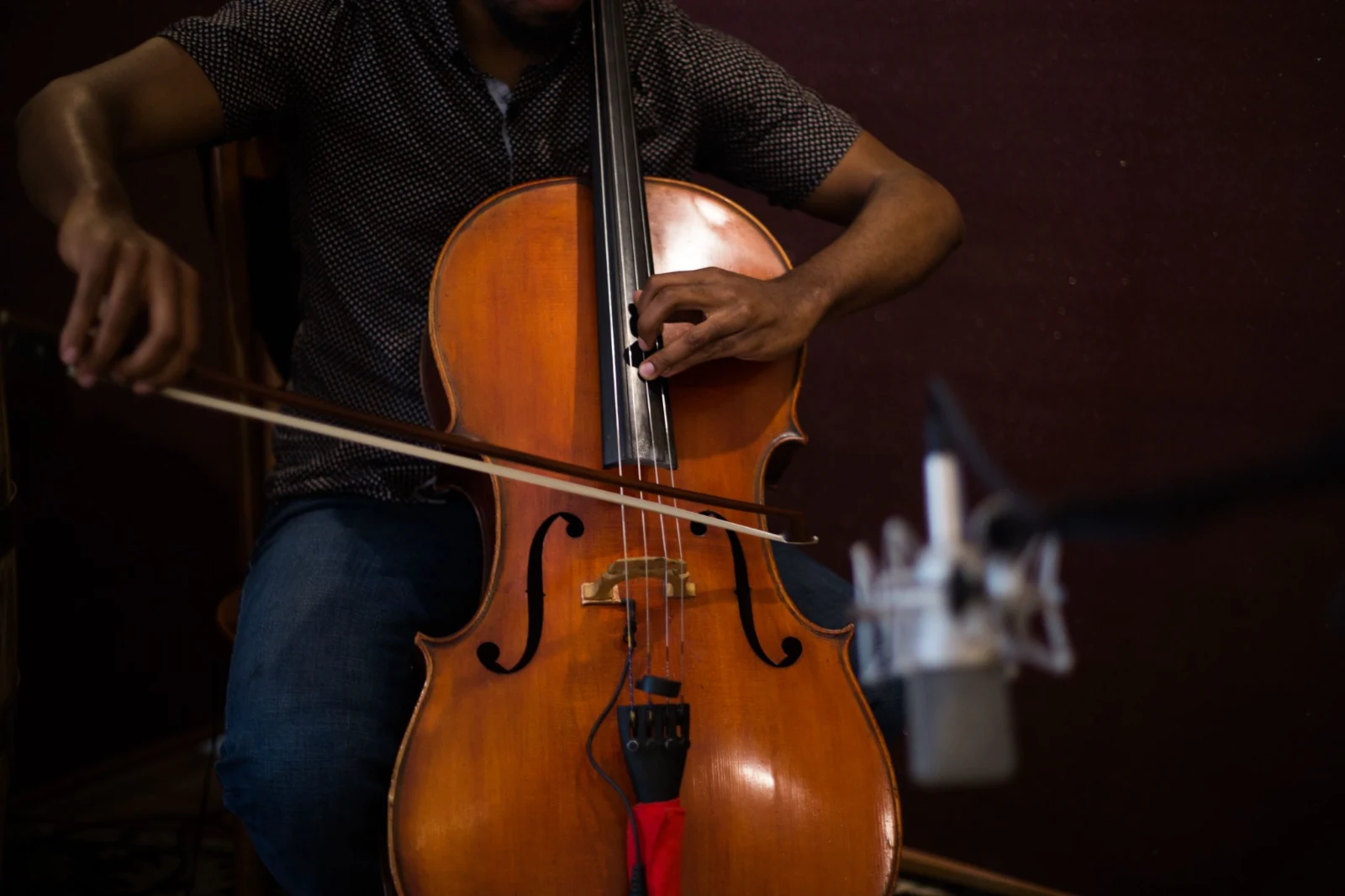
As Wesley continued to explore, the cello emerged as a through-line, our platform voice (performed by session musician Jordan Hamilton). Underneath it, a wide range of percussion samples and textures represent the diversity of creators the platform houses.
One consistent voice, many textures.
The sound design pulls heavily from film projector sounds: mechanical, kinetic, historically loaded. (Wesley worked as a film projectionist as a teenager, so there’s a personal connection to all of this.)
Perhaps most importantly, the audio blurs the lines between music and sound design. It’s a distinctively motion design-friendly approach to scoring that established a sculptural process in which the visuals and the audio influenced each other throughout production.
Chasing recognition, not persuasion
The sentence we kept coming back to in the brief was:
If I care about craft and community, I should be on FrameRate.
We aren’t trying to “sell” to anyone in the traditional sense of that word. We’re trying to be recognizable to a specific group of people, the ones who feel like the platforms they helped build have moved on without them.
If the film works, those people watch it once and know FrameRate is for them.
CREDITS
Studio: The Furrow
Creative Director: Seth Eckert
Producer: David Roux
Designer: Loris F. Alessandria
Animators: Matt Jameson, Paul Slemmer, Peter Cobo, Doug Alberts
Music & Sound Designer: Sanctus Audio
Cellist: Jordan Hamilton
Voiceover Artist: Dacey Else